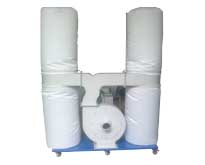
Caple India · Dust collectors
Woodworking dust collectors and extraction systems for Indian factories
Caple supplies single-bag, multi-bag, pulse-jet and central dust collectors for cabinet shops, edge banders and CNC routers, from 3 HP mobile units to 15 HP central plants with anti-static polyester filter media. See them running at our Pelhar and Delhi demo centres.
3–15 HPPower range | 8+Configurations |
Pan-IndiaService and AMC support | 4.7Google rating, 230+ reviews |
Why wood dust is a health and production cost
The International Agency for Research on Cancer (IARC) classifies hardwood and softwood dust as carcinogenic to humans (Group 1), linked to nose and sinus cancer. Exposure is highest in furniture making, especially sanding. Fine dust from routing and sanding stays airborne longest and reaches deepest into the lungs.
Panels add resin to the dust. MDF and particle board are bonded with urea- or melamine-formaldehyde resin. Cutting, routing and sanding release a fine dust cloud of wood dust, free formaldehyde and particles carrying formaldehyde (HSE). Formaldehyde is also an IARC Group 1 carcinogen. When dust is captured at source, measured formaldehyde exposure is negligible (SafeWork NSW). Use E1 or lower-emission boards, and clean with an M-class vacuum, never compressed air or a brush.
8-hour exposure limits: 1 mg/m³ (ACGIH), 2 mg/m³ hardwood (EU), 3 mg/m³ hardwood (UK).
Hidden costs: sick days, tool wear from re-cut chips, dust in spindles, weak glue lines, cleaning hours and fire risk.
Dust classes L, M, H and HEPA filters
| Class | Filtration efficiency | Typical use |
|---|
| L (low hazard) | Above 99% | General clean-up dust |
| M (medium hazard) | Above 99.9% | Wood and MDF dust; the minimum for woodworking |
| H (high hazard) | Above 99.995% | Carcinogenic dust such as asbestos |
| HEPA (H13/H14) | Tested at 0.3 micron | Final filter stage inside M- and H-class units |
The class applies to the complete extractor, not just the filter.
How to size a dust collector: CMH, velocity and pressure
| Parameter | Why it matters and typical value |
|---|
| Airflow (CMH) | Size by machine ports and duct velocity, not by motor HP.
Typical: 400–500 CFM per spindle, 800 CFM per edge bander, 1,000–1,500 CFM per CNC router |
| Air-to-cloth ratio | Airflow ÷ filter area; too high and fine dust passes or blinds the filter.
Typical: About 75–220 m³/h per m² of filter |
| Fan pressure | Suction to overcome duct, hood and filter resistance.
Typical: 2,400–3,400 Pa |
| Pressure drop | Rising drop means a loaded filter and weaker suction; fit a differential-pressure gauge. |
Ducting rules: no leaks, gradual bends, minimum flexible hose, full earthing, and a cyclone before the filter for heavy chip loads.
Duct velocity: the number that keeps suction alive
Airflow moves air; velocity carries dust. Velocity is airflow divided by duct cross-section, so duct size decides whether dust reaches the filter.
| Duct velocity | What happens |
|---|
| Below about 18 m/s | Dust and chips settle, block ducts and build a fire load. |
| About 20 m/s | Design value for dry dust and chips; about 28 m/s for wet or heavy material. |
| Well above design | Noise, wear and wasted power; fan power rises with the cube of speed. |
Example: a 150 mm duct at 20 m/s carries about 1,270 m³/h; a 200 mm duct carries about 2,260 m³/h. Enlarge the main duct in steps as branches join, and check velocity at each machine during commissioning.
Central vs standalone dust collectors
| Factor | Standalone (mobile) | Central (ducted) |
|---|
| Best for | 1–2 machines, or intermittent use | 3 or more machines running together every day |
| Investment | Low; no ducting or civil work | Higher; includes ducting, dampers and controls |
| Dust handling | Many small bags emptied by hand | One discharge point, which can be automated |
| Energy | Runs only with its machine | Efficient when fitted with an inverter and automatic dampers |
| Breakdown | Affects one machine | Affects the whole line |
Many factories combine both: central for the CNC router, panel saw and edge bander, mobile for occasional machines.
Collected dust discharge: manual vs rotary valve
- Manual bags or bins: low cost, but the fan stops for emptying and operators breathe fine dust each time.
- Rotary airlock valve: a motor-driven rotor discharges dust continuously into a bin, skip or briquetting press while extraction runs and suction is held (Powder & Bulk Solids). Suits central and multi-shift systems; for wood dust choose a spark- and flame-rated valve.
Filter cleaning: manual, shaker or reverse pulse jet
| Method | How it works | Best for |
|---|
| Manual | Operator shakes the bags with the fan off | Mobile units, light use |
| Shaker | A motor shakes the sleeves while the fan is off | Medium duty, intermittent use |
| Reverse pulse jet (RPJ) | Air pulses clean filters section by section while extraction runs | CNC routers, edge banders, multi-shift plants |
Manual dampers vs pneumatic dampers
- Manual blast gates are low-cost but rely on operators; one open gate on an idle machine steals suction from the rest.
- Pneumatic dampers open and close with each machine; with a pressure sensor and inverter (VFD), the fan delivers only the air needed. One published example shows annual fan energy falling from 84,000 to about 45,000 kWh (about 46%), roughly ₹3.5 lakh a year at ₹9 per kWh. Verify savings on site.
Fire and explosion safety for dust collectors
- Use anti-static filter media, and earth and bond all ducts and hoses.
- Place the fan on the clean-air side for heavy dust loads.
- Fit sprinklers inside the filter, and explosion vents with non-return valves on larger units.
- Separate fine-dust and chip lines and empty bins often; fine-dust deposits are a fire and explosion hazard (OSHA).
You get a dust collector sized by airflow, duct velocity and filter area, with the right discharge for your factory. You achieve cleaner air, steady suction and a better finish. You save cleaning hours, tooling, power and fire risk.
Dust collector buying questions answered
Which dust collector size do I need?
Add the airflow of every machine that runs at the same time. Caple confirms the size after a site visit.
How often do filter bags need replacing?
Typically every 12–18 months in single shift. Caple stocks replacements in India.
Do Caple dust collectors meet Indian factory norms?
Correctly sized systems are designed to support Factories Act 1948 dust-extraction requirements; compliance depends on installation and air monitoring.
Should I choose a central or a standalone dust collector?
Standalone suits one or two machines; for three or more running daily, central with automatic dampers usually costs less to run.
Do you offer annual maintenance contracts?
Yes. AMCs cover filters, motor and duct checks, with service support across India.
Caple Industrial Solutions · web@caple.in